 CLIO IQ
Conversation Intelligence Software: A Buyer's Guide
Conversation intelligence software records sales conversations and turns them into something a team can act on: coaching, deal insight and accurate CRM records. This guide explains how it works and how to choose one.
Conversation intelligence software records and transcribes sales calls, then analyses them for patterns such as talk ratio, objections, competitor mentions and buying signals. Unlike a plain notetaker, it connects those signals to the deal and the rep, so managers can coach and forecast from what customers actually said.
What conversation intelligence does
Every tool in the category does four things, at different depths:
- Capture. A bot joins scheduled Zoom, Google Meet or Microsoft Teams calls, or the tool connects to a dialer, and records the conversation.
- Transcribe and summarise. Speech becomes searchable text, then a summary with action items.
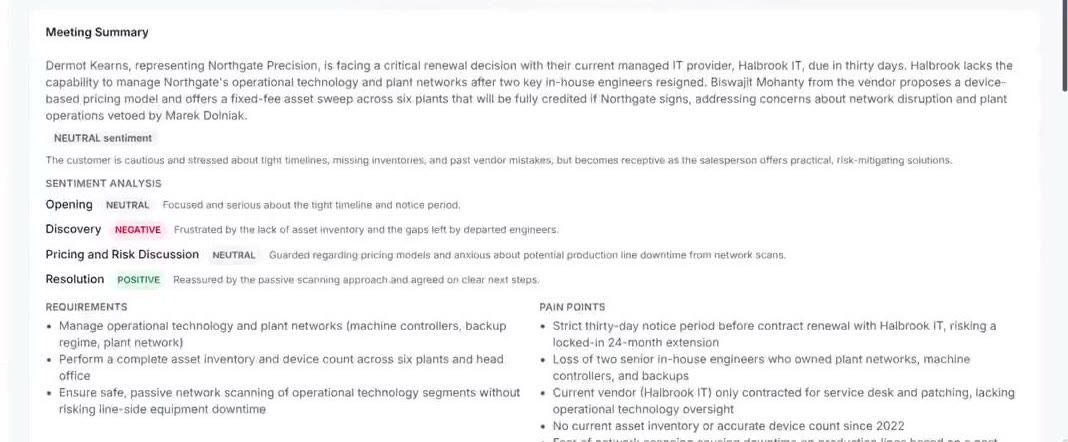
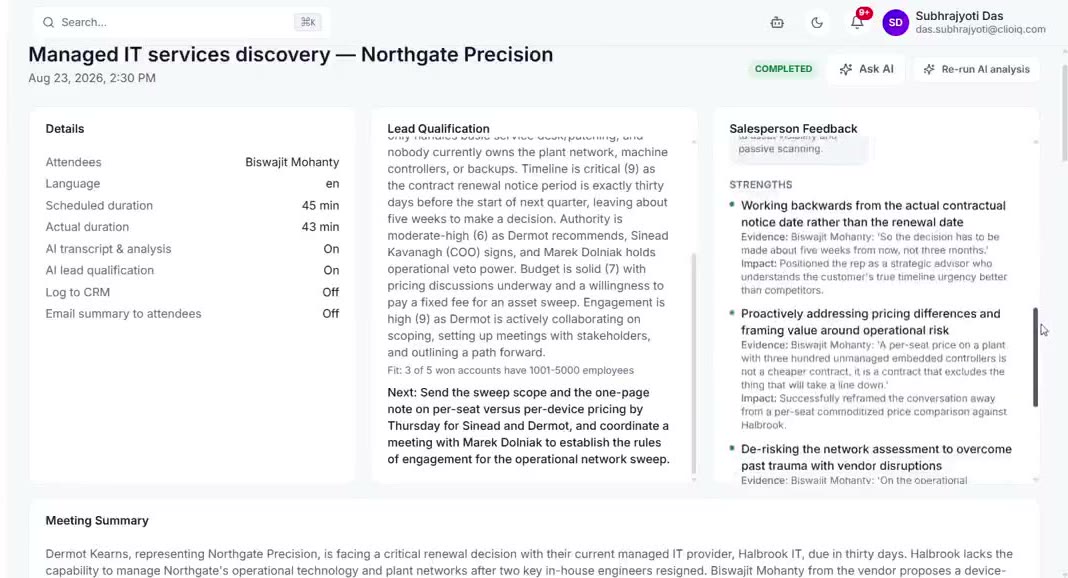
- Analyse. The tool extracts signals: who spoke how much, which questions were asked, which objections came up, which competitors were named, and how sentiment moved.
- Act. The signals feed coaching, deal health, forecasts and the CRM.
Conversation intelligence vs an AI notetaker
| AI notetaker | Conversation intelligence | |
|---|---|---|
| Main output | Transcript and summary | Signals tied to deals and reps |
| Who uses it | The person on the call | Reps, managers, RevOps and leadership |
| Coaching | Rarely | Talk ratio, question rate, objection handling, scorecards |
| Deal insight | No | Deal health or risk, buying signals, next steps |
| CRM | Pastes notes | Updates fields and activities |
The metrics that matter
- Talk ratio. How much of the call the rep spent talking. Discovery calls where the rep talks most of the time are a common coaching flag.
- Question rate. How many open questions the rep asked.
- Objection handling. Which objections were raised and whether they were addressed.
- Commitments. What the buyer agreed to, and by when.
- Risk signals. An unconfirmed budget, a slipping timeline, a new stakeholder, or silence after a call.
A buyer's checklist
- Where are your conversations? Check support for your meeting platforms, and for phone calls if your team sells by phone.
- Who will run it? Enterprise platforms often assume a RevOps owner. Smaller teams need something that works out of the box.
- What happens in the CRM? Ask whether it writes fields or only attaches notes, and whether a person approves the write.
- Is pricing public? Public per-seat pricing makes comparison easy. See our guides to Gong pricing and Avoma pricing.
- What is included, and what is an add-on? Coaching and deal risk are bundled by some vendors and sold separately by others.
- Data handling. Ask where recordings are stored, how long they are kept, and how consent is captured. Clio IQ's approach is on its security page.
How the analysis works
Under the hood, conversation intelligence combines three steps. Speech recognition turns audio into text. Speaker separation works out who said what, which is what makes talk ratio and per-rep coaching possible. Then language models read the transcript for meaning: requirements, objections, commitments and risk. Newer tools also read emails and CRM history, so a statement on a call can be checked against what was promised before.
Common rollout mistakes
- Recording everything, reviewing nothing. Decide in advance which two or three metrics the team will look at each week.
- Turning on CRM sync on day one. Review proposed updates for a week before letting them write to every record.
- Using it to police reps. Teams adopt it faster when it is introduced as admin relief and coaching, not surveillance.
- Skipping consent. Make the recording notice part of the meeting invite and the opening of every call.
How to measure whether it works
Pick measures you already track, and compare a quarter before with a quarter after. Useful ones are hours of CRM admin per rep per week, the share of deals with a next step and close date that match the latest call, ramp time for new reps, and forecast accuracy at the start of the month.
Where Clio IQ fits
Clio IQ is conversation intelligence for teams without a RevOps function. It records Zoom, Google Meet and Microsoft Teams calls and its own built-in meetings, scores each deal after every call, coaches reps on talk ratio, questions and objections, and keeps either its built-in Clio CRM or HubSpot, Salesforce or Zoho up to date. Plans start at $19 per rep per month billed yearly.
For the vendor-by-vendor view, see Compare Clio IQ.
Frequently asked questions
What is conversation intelligence software?
Software that records and transcribes sales conversations, then analyses them for coaching, deal insight and CRM updates.
Is conversation intelligence the same as revenue intelligence?
They overlap. Conversation intelligence focuses on the calls; revenue intelligence also uses emails, CRM data and pipeline history to forecast and flag risk.
Do small teams need conversation intelligence?
Many do, because they have no time to listen to calls. Choose a tool that works without an administrator.
Which meeting platforms does Clio IQ support?
Zoom, Google Meet, Microsoft Teams and its own built-in Clio Meeting. Phone calls are in early access.
Try it on your own calls.
14 days free, no card. Or we'll walk you through it on a real deal.